

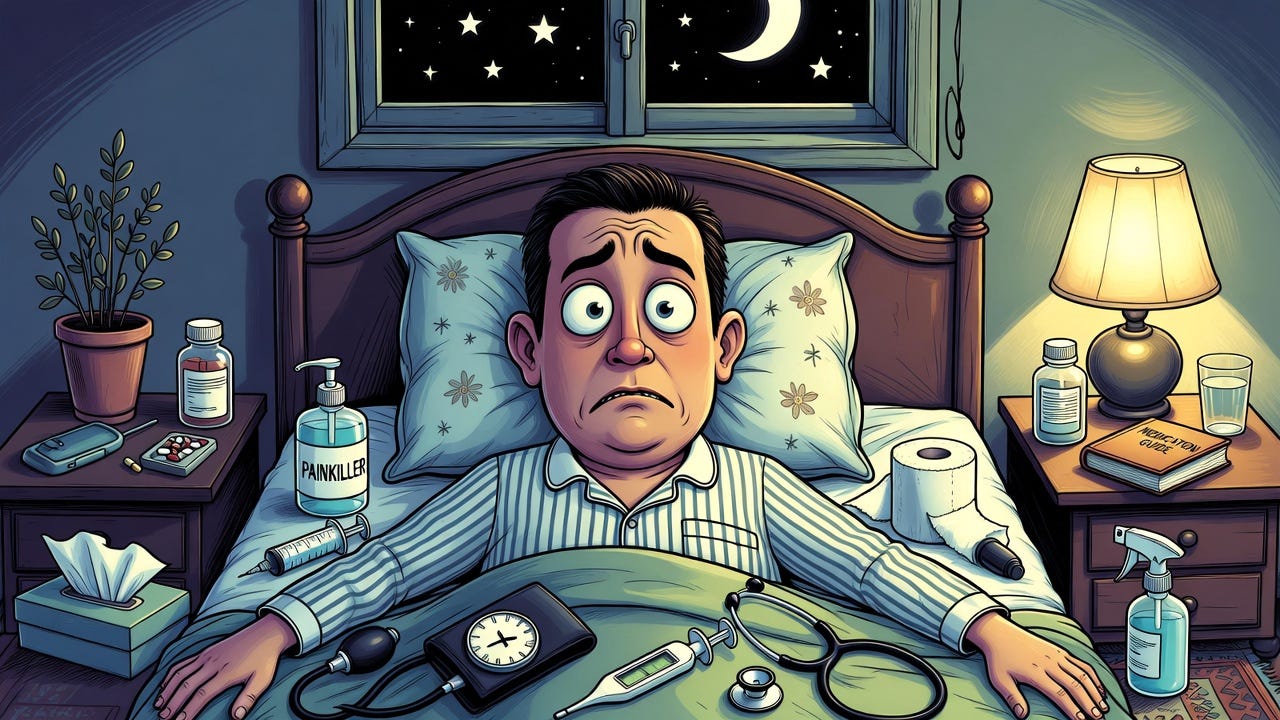
We are manufacturing hypochondriacs on an industrial scale, and the assembly line runs 24/7 through your television, your social feeds, and the way we talk about our bodies.
Flip on the TV and within minutes you’ll meet the cheerful couple strolling on the beach while a soothing voice warns them about the silent killer lurking in their bloodstream. Then comes the smiling woman who “finally” got relief from her “moderate to severe” plaque psoriasis. Next, a silver-haired gentleman thanks his doctor for helping him manage “his” COPD. Every commercial ends the same way: a list of side effects rattled off at auctioneer speed, followed by the friendly reminder to “ask your doctor if [brand-name drug] is right for you.”
These ads don’t just sell pills. They sell the idea that sickness is normal, inevitable, and permanently part of your identity. And we’ve bought it hook, line, and symptom.
Walk into any gathering today and listen to the introductions people give themselves. Not “Hi, I’m Sarah, I love hiking,” but “Hi, I’m Sarah. I have Hashimoto’s.” Or “I’m Mike—my rheumatoid arthritis is acting up today.” The diagnosis has become a badge of honor, a conversation starter, almost a personality trait. We claim these conditions with the same possessive pride we once reserved for our children or our favorite sports teams: *my* fibromyalgia, *my* diabetes, *my* anxiety disorder.
Here’s the uncomfortable truth no one wants to say out loud: the more we focus on, talk about, and emotionally identify with our illnesses, the more we feed them. Call it the law of attraction, neuroplasticity, or plain old self-fulfilling prophecy—whatever label you prefer, the mechanism is brutally simple. What you give your attention and emotional energy to grows.
When you repeatedly declare “my arthritis” or “my chronic fatigue,” you are not being humble or realistic. You are reinforcing neural pathways that keep the body in a defensive, inflamed state. You are signaling to your subconscious that this is who you are now: a sick person. And the body, ever obedient, delivers more of what you’ve ordered.
The pharmaceutical industry understands this perfectly. Their business model depends on customers who identify so completely with their diagnosis that they never imagine a life without it. Why would they cure you when “managing symptoms for life” is far more profitable? The commercials aren’t accidents; they’re psychological operations designed to normalize chronic illness and make you a lifelong subscriber.
Meanwhile, the wellness influencers on the other side of the coin aren’t helping either. They’ve simply replaced “my disease” with “my healing journey,” “my trauma,” or “my detox protocol.” Same possessive language, same endless focus on what’s wrong. The symptoms may shift, but the obsession with pathology remains.
What if we tried something radical instead?
What if we stopped introducing ourselves by our diagnoses? What if we refused to claim illness as property? What if we trained our minds and mouths to speak about health with the same possessive affection we currently lavish on our problems?
Try it for one week. Catch yourself saying “my migraines” and replace it with “the occasional headaches I used to get.” Notice how your body feels when you refuse to own the condition. Pay attention to how your energy changes when you stop feeding the story.
The science is catching up to what ancient wisdom traditions have always known: focused attention is creative power. The placebo effect proves it. The nocebo effect (getting sick from believing you will) proves it in the opposite direction. Every time you scroll past another disease-awareness campaign or recite your symptom list like a resume, you are casting a spell on your own biology.
We don’t need another awareness month. We need an awareness detox.
The next time a commercial tells you to “ask your doctor” about some new wonder drug for a condition you didn’t even know you had, try this instead: change the channel, go for a walk, and repeat to yourself, “My body is strong, resilient, and healing.” It sounds hokey until you realize the alternative—living as a card-carrying member of the Diagnosed—and suddenly it doesn’t sound so crazy.
We are what we focus on.
We become what we claim as “mine.”
Choose wisely what you attach your “my” to.
Live Long And Prosper 🖖,
-Dan
I couldn't agree more. Hypnosis by marketing. Think about why insurance companies have the tallest buildings in just about every city.