

There is something fascinating about looking closely at an eye. What appears from a distance to be simply blue, brown, or green becomes a landscape of intricate fibers, rings, flecks, and variations in color.
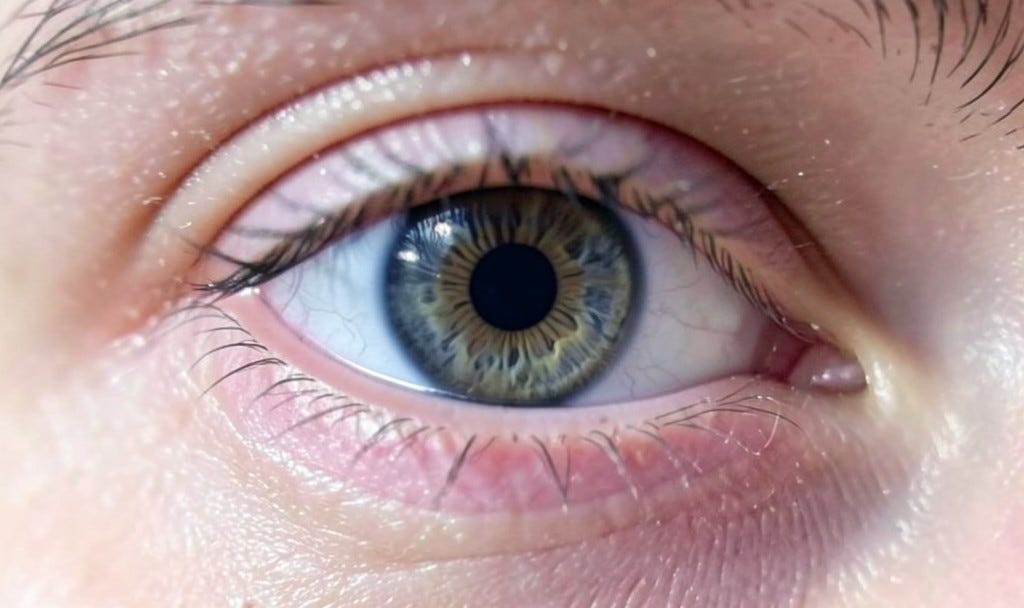
Iridology begins with that closer look.
Within this natural-health tradition, practitioners examine the iris—the colored portion of the eye—and interpret its features through a framework of constitutional patterns and body maps. The interest is not just in a particular symptom, but in the individual: their underlying tendencies and the ways they might approach caring for themselves.
At the heart of the practice is the idea of constitution.
What Does Constitution Mean?
In traditional wellness systems, constitution refers to a person’s underlying makeup—the tendencies and characteristics that make their experience different from someone else’s.
It is a way of asking why two people might respond differently to similar circumstances. Why does one person feel resilient under pressure while another feels depleted? Why does the same routine seem comfortable for one person and difficult for another?
Iridologists approach these questions by interpreting the appearance of the iris. Within their framework, certain patterns are associated with constitutional strengths or areas thought to deserve additional attention.
These interpretations are best understood as part of the tradition’s perspective, rather than as fixed predictions about a person’s health.
A tendency is not a destiny. And no category can capture the whole person.
How the Iris Map Works
One of the most recognizable features of iridology is the iris chart.
These charts divide the iris into sections that practitioners associate with different organs and regions of the body. A practitioner considers both what a feature looks like and where it appears within the chart.
Think of it as a reference map used within the practice—not a literal picture of the organs.
Different schools of iridology use somewhat different charts, terminology, and methods. Some emphasize organ-related interpretations, while others focus more on constitutional patterns and the overall appearance of the iris.
That variation is worth understanding: an iris reading is an interpretation made through a particular system, not simply a photograph that speaks for itself.
What an Iridologist Looks At
An assessment generally considers several features together.
Color and Pigmentation
The overall color of the iris, along with variations and areas of pigmentation, forms part of the practitioner’s assessment.
Within iridology, these features may be used to describe broad constitutional categories. The intention is to explore patterns rather than reduce someone to their eye color.
Fiber Patterns
The iris has a textured appearance, with lines that radiate outward from the pupil. Practitioners examine how these fibers appear to be arranged, including their spacing and the openings between them.
Different traditions assign different meanings to these patterns, often relating them to ideas about constitutional resilience or vulnerability.
Rings and Other Markings
Rings, spots, and other visible features also receive attention. Their interpretation depends on the school of iridology, their location, and the other patterns present.
The important point is that one marking should not become the entire story. A thoughtful reading considers the overall picture rather than attaching a dramatic meaning to an isolated detail.
Where the Practice Came From
Modern iridology developed through the work of European practitioners, including Hungarian physician Ignaz von Péczely and Swedish practitioner Nils Liljequist.
Their observations and interpretations helped shape the systems that later became known as iris analysis.
In the United States, Bernard Jensen became an influential figure in bringing iridology into the natural-health community. His work connected iris interpretation with a broader interest in nutrition and whole-person wellness, and his charts became widely used within the tradition.
As the practice evolved, different schools developed their own approaches. This helps explain why iridology is not one uniform method, but a collection of related interpretive traditions.
Why It Appeals to a Whole-Person Approach
For people drawn to natural health, part of iridology’s appeal is its emphasis on individuality.
Instead of beginning and ending with a symptom, it invites a broader conversation:
What patterns do you notice in your own experience?
What habits help you feel supported?
Where do you repeatedly feel challenged?
How does your daily life fit with what you understand about yourself?
Those questions matter independently of any iris chart.
The most useful conversation is one that connects the practitioner’s observations with the person’s actual history and experience. An interpretation should open a discussion—not override what someone is feeling or turn into an unquestionable verdict.
What a Session May Involve
An iridology session may include a close examination of the eyes or photographs that allow the practitioner to study the iris in greater detail.
The practitioner then explains the patterns they observe and how their particular system interprets them. Depending on their background, the conversation may also include general wellness habits, nutrition, and constitutional tendencies.
The physical examination is noninvasive. The more important consideration is how the information is communicated.
There is a meaningful difference between saying, “Within this tradition, this pattern is associated with a particular tendency,” and declaring, “This marking means you have a disease.”
Iris analysis should not be used to establish a disease diagnosis or dismiss symptoms that deserve appropriate evaluation.
Curiosity Without Fear
A natural-health practice should help people feel more engaged with their well-being—not frightened by every variation in their bodies.
A spot in the iris should not become a frightening prediction. A constitutional description should not become a permanent label. And a reassuring interpretation should not become a reason to ignore something that feels wrong.
There is room to explore traditional approaches while keeping perspective.
You can be curious without accepting every interpretation as certainty. You can appreciate a whole-person philosophy without treating its map as the whole territory.
The Person Matters More Than the Chart
Iridology offers a distinctive lens through which practitioners explore constitution and individuality.
For me, the most interesting part is the invitation to look more closely—to move beyond a one-size-fits-all conversation and consider the person behind the symptoms.
But that attention should always return to the person.
Their story, their lived experience, and their concerns matter more than any category assigned to them. Used with that spirit, the conversation becomes less about finding something wrong and more about understanding how someone wants to care for themselves.