


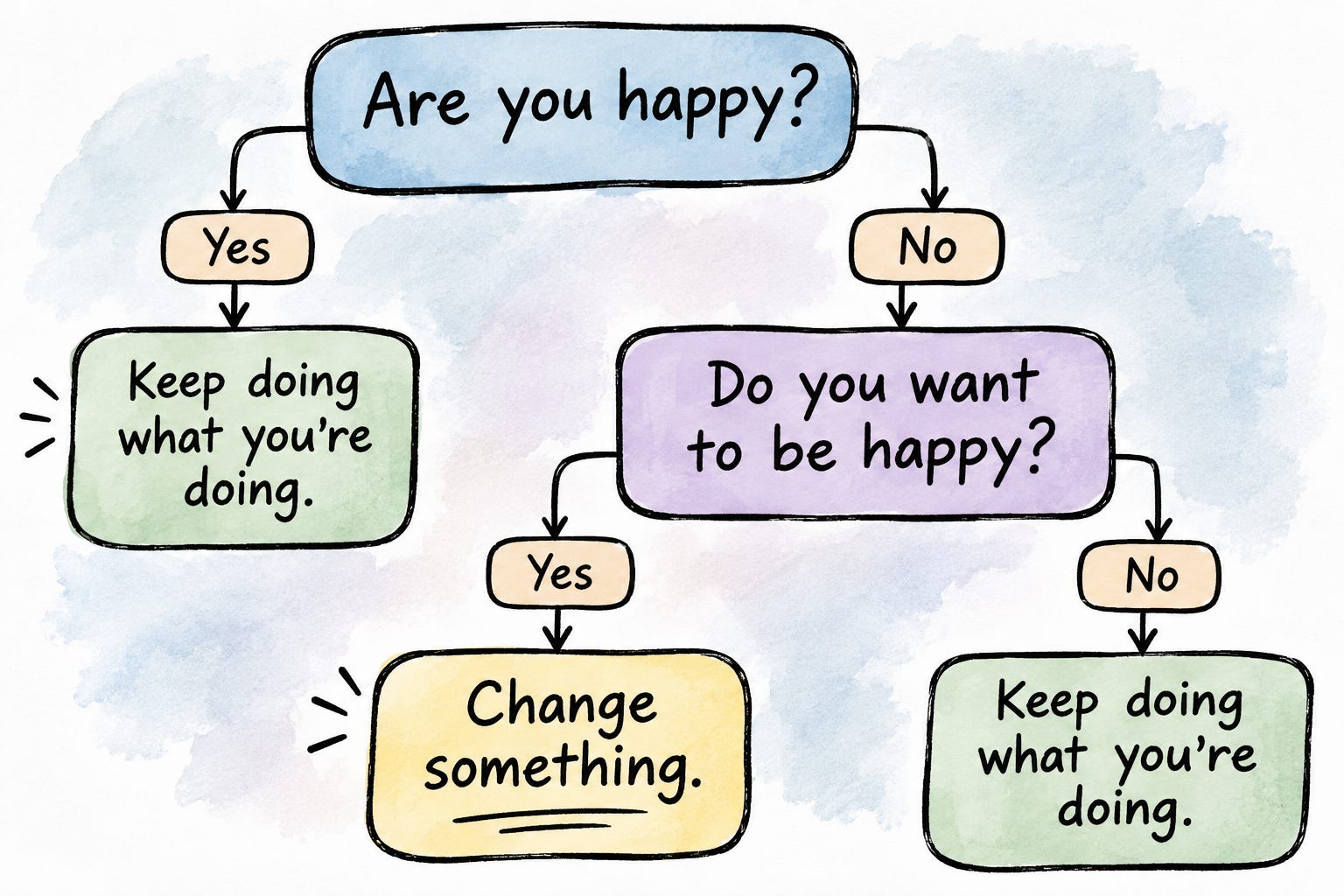
I saw a little flowchart the other day that got me thinking about happiness, and why we resist change even when we know something isn’t working.
It starts with a question.
Are you happy?
If yes, keep doing what you’re doing.
If no, it asks another question.
Do you want to be happy?
If yes, change something.
If no, keep doing what you’re doing.
That’s it. The entire secret to happiness, apparently, reduced to a few boxes and arrows.
Somebody should probably tell the psychologists. We can all go home now.
But the more I looked at it, the more I thought there might actually be something to it.
Some People Seem Determined to Be Miserable
I’ve met people who are absolutely miserable and seem determined to stay that way. And God forbid you suggest they might actually have something to do with it.
That’s usually when the conversation gets interesting. And by interesting, I mean they get pissed off.
Now, before somebody gets pissed off at me, too, I’m not saying everybody who’s unhappy is choosing to be miserable. Life can be brutal. Things happen that we didn’t ask for, can’t control, and wouldn’t wish on anybody.
I’m talking about something different.
I’m talking about the person who complains about the same thing over and over, knows something needs to change, and then proceeds to do absolutely nothing about it.
And I know what you’re thinking. Well, maybe they can’t.
Maybe. But sometimes they can. And sometimes they know they can.
They just don’t.
I’ve seen this in my practice. People come in because something isn’t right. They’re hurting, they’re frustrated, they’re tired of feeling the way they feel. They want to get better.
At least that’s what they tell me. And I believe them.
But sometimes, when we start talking about what might need to change, suddenly there are reasons why that particular thing just isn’t going to happen.
And I get frustrated.
I mean, you came to me because you wanted help. We’re talking about something that might help, and now you’re explaining all the reasons you can’t do it.
Okay. So what exactly are we doing here?
That’s the part of me that wants to say, Fine. Keep doing what you’re doing.
Fortunately, there’s another part of me that’s learned to look a little deeper.
Fear Is a Sneaky Little Bastard
Sometimes what looks like stubbornness is actually fear.
And fear doesn’t always show up trembling in the corner. Sometimes it shows up angry. Sometimes it has a perfectly reasonable explanation for why nothing can change. Sometimes it has a whole list of explanations.
And sometimes it doesn’t even know it’s afraid.
I’ve noticed that when you point out the contradiction to someone, they can get pretty defensive. Which used to make me even more frustrated.
But I’ve come to realize that sometimes you’re not pointing out something they don’t know. You’re pointing out something they don’t want to look at.
There’s a difference.
Maybe they already know something needs to change. Maybe they’ve known for years. But changing it means stepping into something unfamiliar, and that scares the hell out of them.
And here I am, helpfully pointing right at it.
No wonder they’re irritated.
Something interesting happens when I recognize that fear, though. I soften a little.
Which is considerably less satisfying than being annoyed, because now I have to be compassionate.
Instead of thinking, Why won’t you just change? I start wondering, What are you afraid will happen if you do?
And that’s a much more interesting question.
Sometimes I’ll do some emotional work with someone to see if we can uncover what’s behind the resistance. Not to force them into changing, but to see whether we can make the idea of changing a little less frightening.
Because sometimes the thing we’re holding on to isn’t making us happy.
It’s making us feel safe.
Or at least familiar.
Why Familiar Misery Feels Safer Than Change
And familiar can be a powerful thing.
You can be miserable in a situation and still find comfort in knowing exactly how miserable you’re going to be tomorrow. At least there won’t be any surprises.
Change? Well, who knows what might happen?
And apparently, for some of us, that’s worse.
Of course, it’s easy for me to sit here talking about everybody else’s resistance to change. I’ve got a pretty good view of it from my side of the adjusting table.
But I have to wonder how many times I’ve done exactly the same thing.
How many times have I known something wasn’t working but kept doing it anyway? How many times have I come up with a perfectly logical explanation for why I couldn’t change something?
And how many of those explanations were just fear dressed up in a nice suit?
Probably more than I’d care to admit.
Which brings me back to that stupid little flowchart.
Are you happy?
No.
Do you want to be happy?
Of course.
Then change something.
Whoa. Hang on.
Nobody said anything about me changing.
I thought we were talking about making my circumstances better. Or getting somebody else to behave differently. Or having the universe finally recognize that I’ve been right about everything all along.
Now you’re telling me I might have to do something?
That’s a whole different conversation.
Wait. You Mean I Have to Change?
Maybe that’s the problem.
We say we want to be happy, but we also want to be right. We want to feel safe. We want to be comfortable. We want to know how everything is going to turn out before we take the first step.
And sometimes those things are more important to us than happiness. At least in the moment.
So maybe the flowchart needs another box.
Are you happy?
No.
Do you want to be happy?
Yes.
Are you willing to change something?
Well...
Now that’s a different question.
And I suppose I should probably ask it of myself before I start asking everybody else.
Although I’d still prefer it if everybody else would change first.
Live Long and Prosper,
-Dan
Or, if subscriptions aren’t your thing, you can always buy me a coffee.
Either way, thanks for reading. I appreciate you being here.
— Dan
Maybe you want to check out some of these other posts:


Love this poem. An excerpt from the Prisoner of Chillon. My apologies if I replied with it before.
It might be months, or years, or days— I kept no count, I took no note— I had no hope my eyes to raise, And clear them of their dreary mote; At last men came to set me free; I ask'd not why, and reck'd not where; It was at length the same to me, Fetter'd or fetterless to be, I learn'd to love despair. And thus when they appear'd at last, And all my bonds aside were cast, These heavy walls to me had grown A hermitage—and all my own! And half I felt as they were come To tear me from a second home: With spiders I had friendship made And watch'd them in their sullen trade, Had seen the mice by moonlight play, And why should I feel less than they? We were all inmates of one place, And I, the monarch of each race, Had power to kill—yet, strange to tell! In quiet we had learn'd to dwell; My very chains and I grew friends, So much a long communion tends To make us what we are:—even I Regain'd my freedom with a sigh